What is documented, and what is repeated
Most of what is said about origami's past is repeated rather than recorded. We separate the two. Every entry below carries its source; where the source is a story with no document behind it, we say so.

-
105🗣 repeated, unverified
Paper is invented in China — and origami does not follow
The most repeated sentence about origami's beginning is that it started in China, soon after paper itself. There is no evidence for the second half. Paper surviving from the Former Han dynasty shows no trace of folding, and the claim rests on the assumption that folding must follow paper closely. It may have. We cannot show that it did.
Source: Hatori Koshiro, «History of Origami», K's Origami: «This opinion is based on the conjecture that origami started right after the invention of paper, for which we have no evidence.» ↗ -
1680📄 documented
The oldest unambiguous record: a poem
The earliest document that unmistakably describes recreational paper folding is not a manual but a poem. Ihara Saikaku writes of folded butterflies — ocho and mecho, the male and female pair used to dress sake vessels at weddings. A passing line in verse is the first firm ground we have.
Source: Ihara Saikaku, 1680. Cited in Hatori Koshiro, «History of Origami»: «The oldest unequivocal document of origami is a short poem composed by Ihara Saikaku in 1680.» ↗ -
—🗣 repeated, unverified
The wish granted for a thousand cranes
Books referring to «a thousand cranes» appear in the late seventeenth century, so the folding is old and documented. The promise attached to it — fold a thousand and a wish is granted — is repeated everywhere as an ancient legend, but we have not found a primary source that dates it. Old practice, undated promise.
Source: Late-17th-century Japanese books reference «paper cranes» and «one thousand cranes». No primary source located for the antiquity of the wish tradition itself. ↗ -
1764📄 documented
Tsutsumi no Ki — folding as etiquette, not play
Ise Sadatake sets down thirteen ceremonial wrappings: how a gift is enclosed, how the paper declares what is inside and who sends it. This is older than any recreational manual, and it is a different practice. Calling it «the first origami book» blurs two traditions that meant different things to the people who used them.
Source: Ise Sadatake, «Tsutsumi no Ki», 1764. Thirteen ceremonial folds. Discussed in Hatori Koshiro, «History of Origami». ↗ -
1797📄 documented
Sembazuru Orikata — the first book of folding for pleasure
Akisato Rito publishes instructions for forty-nine connected cranes, cut and folded from a single sheet. «Sembazuru» reads as «a thousand cranes», but here it means dozens of birds joined at wing or beak — a technical feat, not a count. This is the earliest published book of folding done for its own sake.
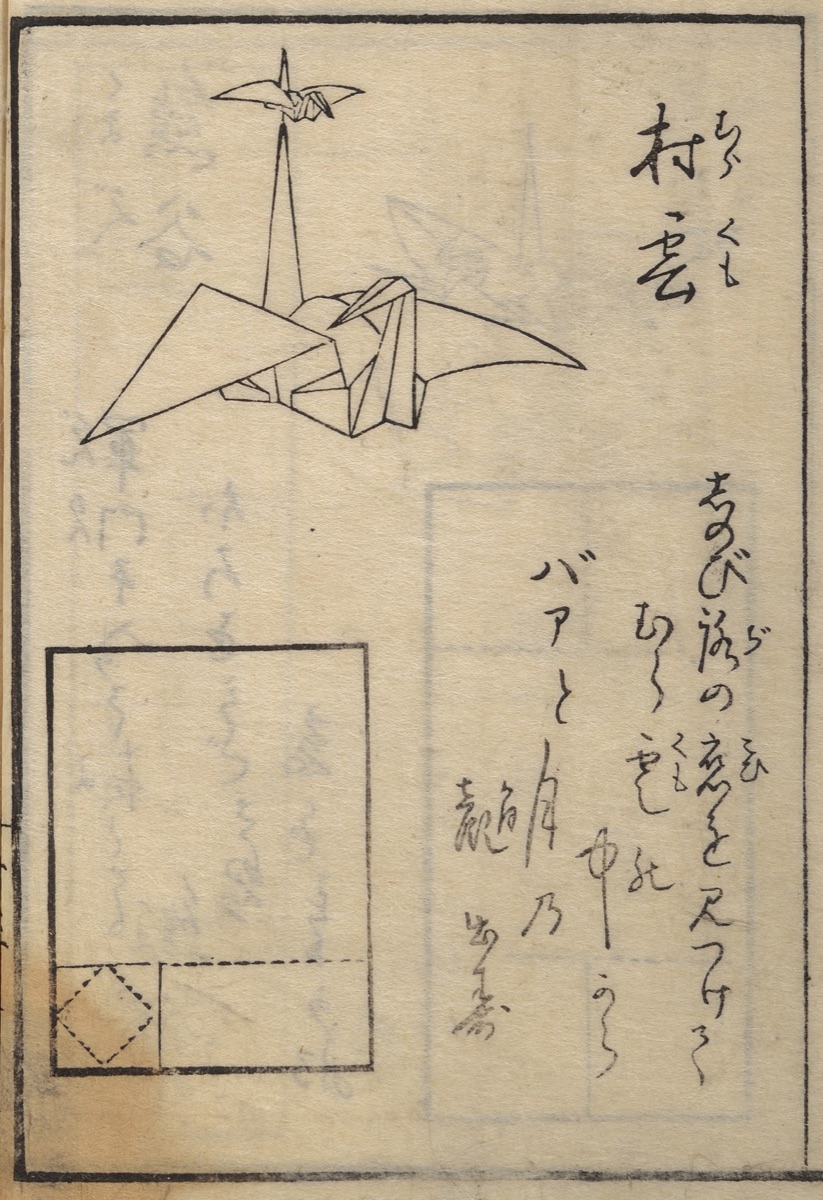
Hiden Sembazuru Orikata, 1797. Shimokōbe Shūsui (d. 1797). The Metropolitan Museum of Art, New York (2013.824). Public domain. Source: Akisato Rito, «Sembazuru Orikata», 1797. 49 linked cranes from one sheet. Hatori Koshiro, «History of Origami». ↗ -
1837📄 documented
A second line begins, in Germany
Friedrich Fröbel opens his kindergarten at Blankenburg. Among the «occupations» he designs for small children is paper folding — Faltungen — meant to teach form and symmetry through the hands. European and Japanese folding of this period look so unlike each other that they appear to have grown separately. Origami has more than one root.

Foldsong drawing — a Fröbel «form of beauty»: a square folded into eightfold symmetry. Geometry drawn from the construction, not from a photograph. Source: Friedrich Fröbel (1782–1852), kindergarten founded at Blankenburg, 1837; paper folding among the «occupations». Hatori Koshiro: «European and Japanese classic origami were so different that they seem to have developed independently.» ↗ -
1845📄 documented
Kayaragusa — and a title that was never its own
Adachi Kazuyuki records a large collection of models around 1845. The work is widely called «Kan no mado», a name that comes from a mistake in a copy and has been repeated ever since. The models are real; the famous title is not.
Source: Adachi Kazuyuki, «Kayaragusa», c. 1845. Hatori Koshiro: «sometimes wrongly called ‹Kan-no Mado›, based on an error on a copy.» ↗ -
1954📄 documented
A language for folding
Akira Yoshizawa publishes «Atarashi Origami Geijutsu» and with it a way of drawing folds: dashes for one direction, dots and dashes for the other, arrows for what the hand does. Robert Harbin and Samuel Randlett add symbols and carry it abroad; Randlett's «The Art of Origami» (1961) sets it down as a standard. Every diagram on this site is drawn in it.
Source: Akira Yoshizawa, «Atarashi Origami Geijutsu», 1954. Robert Harbin, «Paper Magic», 1956. Samuel Randlett, «The Art of Origami», 1961 — first description of the Yoshizawa–Randlett system. ↗ -
1955📄 documented
Sadako Sasaki
Sadako Sasaki was born in Hiroshima on 7 January 1943 and died of leukaemia on 25 October 1955, aged twelve. While ill she folded paper cranes. Her story carried the crane out of Japan and into the rest of the world, and it is why most people who have never folded anything know what a paper crane means.
Source: Sadako Sasaki (7 Jan 1943 – 25 Oct 1955), Hiroshima. ↗ -
1966📄 documented
The rules are written down — earlier than the names suggest
Two papers by S. Murata set out the angle condition for flat folding in the general case, together with the mountain-and-valley count. Both results are known today by other names. The record is older than the labels.
Source: S. Murata, two papers, 1966 — general angle condition and the mountain/valley count. Noted in the literature on Kawasaki's theorem. ↗ -
1976📄 documented
Huffman — «Curvature and Creases»
David A. Huffman, better known for a method of compressing data, writes a paper on what a sheet of paper can and cannot do when it is creased. He and Kôdi Husimi had each observed that in a flat-folded vertex of four creases, opposite angles sum to a straight line — the small case of a rule that would later be stated in general.
Source: Huffman, D. A., «Curvature and Creases: A Primer on Paper», IEEE Transactions on Computers, 1976. Four-crease observation also by Kôdi Husimi. ↗ -
1977🗣 repeated, unverified
«She folded only 644» — a detail from a novel
The version almost everyone repeats is that Sadako fell short at 644 cranes and her friends folded the rest. That account comes from Eleanor Coerr's 1977 children's novel. An exhibit at the Hiroshima Peace Memorial Museum states that she reached a thousand by the end of August 1955 and folded some three hundred more; her brother Masahiro says the same. The invented detail travelled further than the record.
Source: Eleanor Coerr, «Sadako and the Thousand Paper Cranes», 1977 (novelised). Counter-account: Hiroshima Peace Memorial Museum exhibit; Masahiro Sasaki, «The Complete Story of Sadako Sasaki». ↗ -
1970s–80s📄 documented
One rule, three people, no contact
The general angle condition — alternate angles around a vertex sum to a straight line — was reached independently by Toshikazu Kawasaki, by Stuart Robertson and by Jacques Justin within a few years of each other. It is often called the Kawasaki–Justin theorem for this reason. Every fold on this site is checked against it.

Foldsong drawing — a vertex where six creases meet. Alternate angles sum to a straight line; mountains and valleys differ by two. Source: Independent discovery by T. Kawasaki, S. Robertson and J. Justin, late 1970s – early 1980s; also known as the Kawasaki–Justin theorem. ↗